

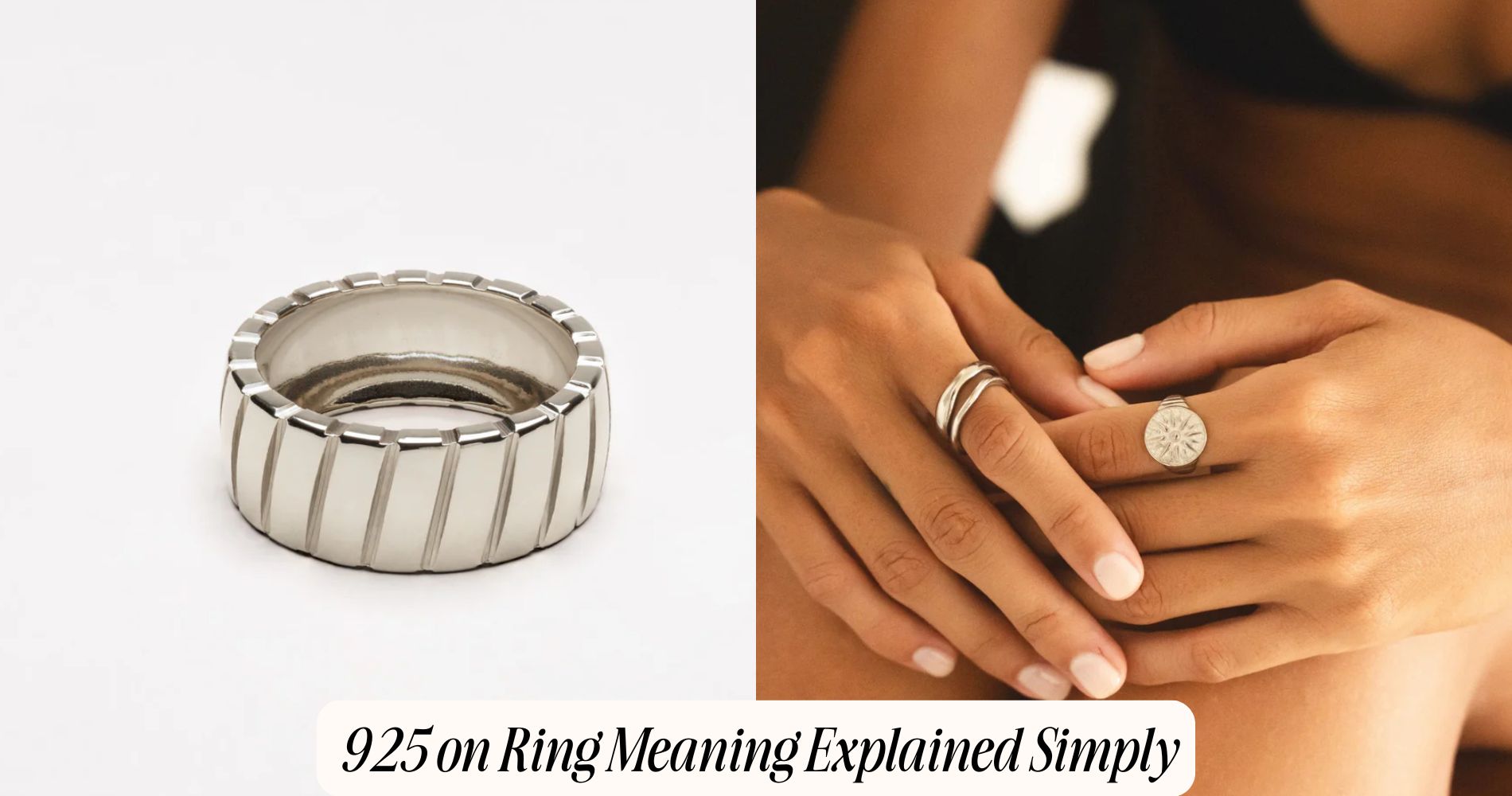
925 on Ring Meaning Explained Simply
Understand 925 on ring markings by knowing they identify sterling silver—92.5% pure silver blended with 7.5% alloy (most often copper) to enhance hardness and everyday durability while preserving silver’s natural shine. The stamp confirms metal composition, not craftsmanship or thickness, so longevity also depends on alloy quality, joints, and finish. You can verify authenticity with simple checks like magnet response, ice melt behavior, or nitric testing. If you’re exploring alternative styles in warmer tones, browse our Minimalist Gold Rings collection. Keep reading for step-by-step verification tips and precautions.
What “925” Means : Why 92.5% Matters
"925" stamped on a ring tells you the metal's silver purity: the piece contains 92.5% elemental silver and 7.5% alloy.
You should read that mark as a quantitative specification of composition and performance. The 925 significance lies in balancing malleability and strength: pure silver (99.9%) is too soft for durable wear, so the 7.5% alloy—commonly copper—raises hardness and wear resistance without markedly altering conductivity or appearance.
As a buyer, you'll use silver purity to predict tarnish rate, tensile behavior, and suitability for settings or repair.
Testing protocols (assay, XRF) report the same ratio; hallmarking provides legal and commercial assurance.
You’ll prioritize items with verified 925 markings when you need predictable mechanical and chemical properties.

How Sterling Silver Is Made
When you make sterling silver, manufacturers start by precisely alloying pure silver with a controlled amount of metal—typically copper—to reach the 92.5% Ag composition. They then refine, melt, and cast or mill the alloy under monitored conditions to guarantee homogeneous grain structure and targeted mechanical properties.
You’ll follow controlled melting cycles to dissolve additives, use fluxing to remove oxides, and sample the melt to verify sterling composition via spectroscopy or fire assay. After casting or continuous casting, you’ll hot-work and anneal to refine dendritic structure, then cold-work and final anneal to tune hardness and ductility.
Surface treatments—polishing, passivation, or plating—are applied depending on end-use. Throughout, quality control records compositions and thermal profiles to confirm consistent performance of silver alloys.
3 Quick Tests to Check a 925 Ring
How can you rapidly assess whether a ring stamped “925” is genuine without lab equipment?
You perform simple, targeted checks that focus on ring authenticity and metal composition. First, use a magnet: sterling silver is weakly diamagnetic, so a strong attraction indicates base metal or plating.
Second, inspect markings and seams with a loupe; inconsistent stamps or exposed base metal at wear points suggest plating over a different metal.
Third, do an ice test: silver’s high thermal conductivity will melt ice faster than common alloys.
Fourth, apply a non-destructive nitric acid test kit to a small inconspicuous area; a creamy reaction indicates sterling, green suggests copper or brass.
Record observations; combine results for a reliable, analytical assessment of authenticity.

What the 925 Stamp Doesn’t Reveal About Quality
Although the 925 stamp confirms a silver content of roughly 92.5% copper-silver alloy, it doesn't tell you anything about craftsmanship, alloy treatment, surface finish, or durability—you'll need to assess those separately.
You should evaluate quality differences by inspecting joint integrity, solder quality, and consistent thickness; these factors influence mechanical strength more than the hallmark.
Surface finish and plating procedures (if any) affect wear resistance and color stability, so examine microscopic tooling marks and uniformity.
Heat treatment, work hardening, and alloying trace elements alter hardness and fatigue life; ask for metallurgical data when needed.
For authenticity checks beyond the stamp, combine acid tests, XRF analysis, and reputable documentation.
Use objective metrics rather than relying solely on the 925 mark.
Care, Cleaning, and Storage for 925 Rings
Knowing the limitations of the 925 stamp, you should also manage care, cleaning, and storage to preserve both appearance and mechanical integrity.
You’ll remove contaminants promptly: sweat, cosmetics, chlorinated water and acidic residues accelerate corrosion and solder joint fatigue. Use targeted cleaning methods — mild detergent with lukewarm water and a soft brush for routine soil; commercial silver cleaner for tarnish, applied briefly and rinsed thoroughly; ultrasonic cleaners only if settings and mountings are verified.
Dry completely to prevent crevice corrosion. Inspect prongs, bezels and soldered seams after each cleaning cycle.
For storage solutions, separate pieces in fabric pouches or anti-tarnish envelopes to avoid abrasion and galvanic contact. Control humidity with silica gel and avoid prolonged exposure to sulfurous compounds.
Follow these protocols to extend functional life.
Buying 925 Rings: Prices, Alternatives, and Tips
When you shop for 925 rings, focus on measurable factors—silver weight, alloy composition, finishing, and workmanship—that drive price and performance so you can compare offers objectively.
Use a buying guide checklist: hallmark verification, gram weight, thickness, solder quality, and surface treatment. For price comparison, normalize cost per gram and adjust for plating or gemstones; record vendor return policy and warranty.
Consider alternatives: sterling with higher silver purity isn't standard, so evaluate silver vermeil or stainless steel for durability and lower maintenance.
Inspect construction under magnification for seams, prongs, and internal stamps. Negotiate based on measured weight and material tests. Retain receipts and documentation for future resale valuation or repair.
Prioritize quantifiable metrics over marketing claims.

Frequently Asked Questions
Can 925 Silver Cause Skin Discoloration or Allergies?
Yes — you can get skin reactions from 925 silver; nickel or copper alloyed with sterling often act as allergy triggers, so you'll experience discoloration, rash, or irritation if you're sensitized to those metals, especially with prolonged exposure.
Is 925 Silver Hypoallergenic for Sensitive Skin?
No, 925 silver isn’t guaranteed hypoallergenic; alloy composition varies. You’ll analyze 925 silver types for copper or nickel content, correlate with skin sensitivity, and choose higher-purity or rhodium-plated options to minimize reactions.
Does 925 Mean Silver Is Tarnish-Proof?
No — 925 indicates sterling silver composition, not tarnish-proof; you’ll need tarnish prevention measures. With proper silver care (cleaning, anti-tarnish storage, protective coatings), you’ll considerably slow oxidation but not eliminate it entirely.
Can 925 Jewelry Be Resized or Soldered Safely?
Yes — you can resize or solder 925 silver, but you’ll need proper resizing techniques and controlled soldering methods; a skilled jeweler uses heat control, compatible silver solder, and careful annealing to avoid warping, porosity, or finish loss.
Is 925 Sterling Suitable for Engraving or Stone Setting?
Yes — you can engrave and set stones in 925 sterling; its hardness and malleability suit engraving techniques and common stone settings, though careful tool choice, heat control, and experienced hands prevent chipping, distortion, or prong failure.
Conclusion
In short, 925 signals sterling silver: 92.5% pure silver alloyed for hardness and durability. You’ll judge authenticity via hallmark verification, magnet, nitric acid, and density checks, though these don’t measure finish, craftsmanship, or plating. Maintain alloy integrity by limiting exposure to chemicals, polishing with a silver cloth, and storing in anti-tarnish packaging. When buying, weigh composition against price and alternatives (silver-plated, fine silver, or white gold) to match performance and budget.






%20to%20enhance%20hardness%20and%20everyday%20durability%20while%20preserving%20s...)
コメントを書く
このサイトはhCaptchaによって保護されており、hCaptchaプライバシーポリシーおよび利用規約が適用されます。