


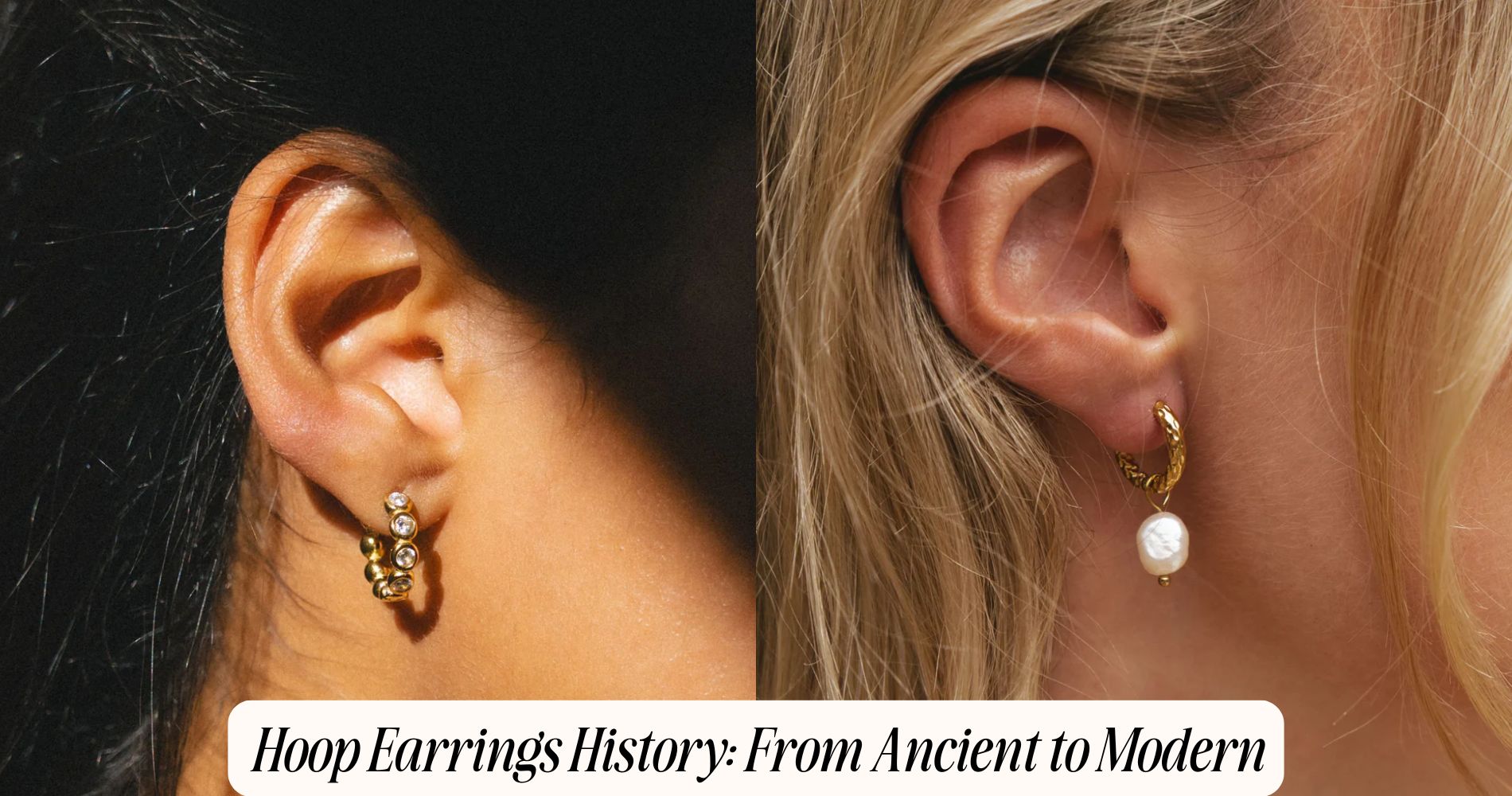
Hoop Earrings History: From Ancient to Modern
Explore hoop earrings history from their earliest roots in third-millennium BCE Mesopotamia and Egypt, where gold and bronze rings symbolized rank, gender, and ritual identity. Across ancient Africa, Nubia, Greece, and Rome, hoop size, materials, and craftsmanship reflected social status, trade connections, and marital or civic roles. Later, pre-Columbian cultures and Victorian-era revivals reinterpreted the form through evolving techniques and fashion movements. Today, hoops carry layered meanings of heritage, empowerment, and everyday style—seen in modern designs like our Hypoallergenic Hoop Earrings collection. Keep reading to uncover the full cultural journey behind this timeless accessory.
Why Hoop Earrings Matter Across Cultures
Because adornment often encodes identity and power, hoop earrings have persisted as compact yet potent cultural markers across time and place.
You examine them as lenses into social organization: size, material, and wear patterns signal status, age-set, gender, and resistance.
In ethnographic terms, their cultural significance emerges through ritual use, guild production, and symbolic exchange; you trace meaning not just to aesthetics but to networks of trade and craft knowledge.
Their global influence is evident where local forms hybridize with introduced metals and motifs, producing regionally distinct repertoires that still reference shared geometries.
When you analyze iconography, law, and commerce together, hoop earrings reveal structural relations—colonial imposition, diasporic memory, and contemporary reclaiming—making them rigorous subjects for comparative study.
Earliest Hoops: Mesopotamia & Egypt
By the third millennium BCE, hoop earrings appear in the archaeological and iconographic records of both Mesopotamia and Egypt, and you can track their emergence through burial assemblages, temple inventories, and visual media.
You’ll note finely worked gold and bronze hoops demonstrating ancient craftsmanship—techniques like hammering, annealing, and simple soldering that created consistent circular forms.
In Mesopotamia, they occur with cylinder seals and status markers; in Egypt, they accompany funerary goods and are depicted on deities and elites, signaling social identity.
You’ll interpret inscriptions and find-spots to assess cultural significance: hoops functioned as markers of rank, gendered adornment, and exchangeable wealth.
Careful provenance and typological comparison let you trace chronological changes without conflating adjacent African traditions.
Hoop Earrings in Ancient Africa & Nubia
Although often discussed alongside Egyptian jewelry, hoop earrings developed distinct forms and meanings across ancient African societies—especially in Nubia—so you should treat their evidence on its own terms.
You’ll encounter burial assemblages, temple reliefs, and metalwork showing locally preferred proportions, alloys, and mounting techniques that reflect ancient craftsmanship tailored to Nubian aesthetics and resources.
When you analyze finds, note variability: simple bronze rings, gold-plated hoops, and composite designs combining beads and wire.
Their placement in graves and iconography suggests layered cultural significance—markers of age, status, community affiliation, and funerary identity.
Greek and Roman Hoops: Status, Gender, Trade
Moving from Nubian practice to the Mediterranean, Greek and Roman hoop earrings developed their own meanings within urban markets, legal codes, and trade networks rather than simply borrowing Nile Valley forms.
You’ll see Greek symbolism tied to civic identity and mythic motifs—small hoops often bore iconography alluding to Aphrodite or protective motifs, signaling status without ostentation.
In Roman fashion hoops became more overt markers: material, size, and security in law could denote class and marital status, and elite women wore gold hoops to display wealth.
You’ll note trade routes from Asia Minor and North Africa supplied alloys and styles, so merchants and workshops standardized sizes and stamps.
Reading inscriptions and legal texts helps you trace how gendered norms and commerce shaped hoop use.

Pre-Columbian Hoops: Materials and Symbolism
Adornment in many Pre-Columbian cultures served as a visual language, and hoop earrings were among its most consistent signs of identity and belief.
You’ll observe that artisans selected Pre Columbian materials—gold, silver, copper alloys, shell, and bone—based on availability, status, and ritual function. Excavations show varying diameters and cross-sections tied to regional aesthetics; coastal communities favored shell hoops, highland elites preferred hammered gold.
When you study iconography and burial contexts, Spiritual symbolism appears repeatedly: hoops signified lineage, cosmological cycles, and negotiated power between human and deity.
You can trace standards of manufacture and ornament placement to infer social roles; earring wearers are often depicted alongside ritual paraphernalia. This evidence lets you interpret hoops as deliberate communicative devices, not mere decoration.
Materials & Techniques: Bronze Wire to Gold Casting
When you trace the technological path from bronze wire to lost-wax and direct-gold casting, you see how material choices shaped form and social meaning in hoop earrings across regions.
You notice that early bronze techniques favored drawn and hammered wire, producing resilient, thin hoops suitable for daily wear and symbolic rites. In archaeological contexts, joins, annealing marks, and patina tell you about workshop practice and regional variants.
Shifting to gold, you’ll find both lost-wax and direct-gold casting allowed thicker, more sculptural profiles, hollow tubes, and repoussé ornamentation, changing weight distribution and wearability.
Examining tool marks, alloy composition, and finishing—filing, burnishing, granulation—lets you read technological intent and the social signals encoded in metal choice.

Trade, Technology, and Changing Hoop Designs
As trade networks expanded and metallurgical knowledge spread, hoop designs adapted quickly to new materials, tools, and consumer tastes, so you can read economic and technological connections in their changing profiles.
You’ll trace how trade routes transmitted not just metals but motifs, soldering techniques, and preferences for scale.
Comparative analysis shows local workshops integrating stamped decoration from one region with lost-wax casting from another, producing hybrid forms that signal both prestige and accessibility.
You can observe how improvements in wire drawing and joinery enabled thinner, larger hoops while mass-production later standardized proportions.
Attention to provenance and workshop marks lets you reconstruct networks of exchange and craft transmission, demonstrating design evolution as an index of shifting markets, available technology, and social taste without assuming linear progression.
Victorian to 20th-Century Hoop Revivals
Building on the commercial and technical exchanges that reshaped hoop forms, the Victorian era and the subsequent century revived and reinterpreted hoops in ways that reflected shifting social values, industrial capacity, and fashion cycles.
You’ll note Victorian aesthetics favored sentimentality and intricate surface work: hairwork lockets, repoussé, and modestly sized hoops signaled mourning or domestic virtue.
As industry mechanized, you’ll see production standardize dimensions and lower costs, enabling wider ownership.
In the early 20th century, designers referenced historic motifs while adapting to changing silhouettes; Art Nouveau gave organic lines, Art Deco introduced geometric precision, and mass-market jewelry echoed 20th century trends toward boldness and accessibility.
You should read these shifts as dialogues between technique, class aspiration, and evolving gender norms.
Contemporary Meanings: Identity, Politics, Pop Culture
Although hoop earrings have long circulated through technical and fashion histories, today they operate as potent markers of identity, politics, and pop culture that you can read at multiple social scales.
You’ll notice how celebrities, activists, and everyday wearers use hoops to signal belonging—ethnic pride, feminist stance, street credibility—while designers and brands mediate those signals through scale, material, and context.
You should also interrogate tensions around cultural appropriation when dominant industries profit from marginalized aesthetics without acknowledgment.
In academic and journalistic accounts you’ll find hoops framed as expressions of feminine empowerment and resistance, yet their meanings shift across class, race, and gender.
Attending to these layered readings helps you map how a simple circle circulates complex social narratives.
Spotting and Caring for Vintage Hoop Earrings
Spotting vintage hoop earrings requires a trained eye for small but telling details: construction techniques, patina, maker's marks, and signs of repair all help you distinguish genuine age from deliberate distress or modern reproductions.
You should document clasps, solder seams, and hallmark placement, comparing them with dated catalogs or reference databases to support vintage identification.
Inspect surfaces under magnification for wear patterns consistent with prolonged use rather than uniform artificial aging.
For earring maintenance, clean gently with appropriate solvents, avoid ultrasonic baths for fragile alloys, and store pieces separately to prevent abrasion.
When restoration is needed, consult a conservator who’ll stabilize joins and preserve provenance.
These practices keep both aesthetics and historical integrity intact for scholarship and collection.

Frequently Asked Questions
How Do Hoop Earrings Affect Ear Health and Risks During MRI Scans?
You should remove hoop earrings before MRI scans: metallic hoops can compromise MRI safety and cause heating or artifacts, and poorly cleaned hoops can increase ear infection risk, so sterilize, inspect, and avoid wearing them during imaging.
Can Hypoallergenic Hoop Materials Prevent Earlobe Tearing Over Time?
Yes — choosing hypoallergenic materials can reduce chronic inflammation and irritation, which helps earlobe care; however, they won’t fully prevent tearing from heavy hoops, trauma, or stretched tissue without proper weight and wear management.
Are There Cultural Appropriation Concerns When Wearing Traditional Hoop Styles?
Yes — you should consider cultural significance when adopting traditional hoop styles; you’re negotiating fashion trends and heritage, so research origins, credit communities, avoid stereotypes, and support artisans to respect contexts and reduce appropriation risks.
How Should Hoop Size Be Chosen for Face Shape and Personal Balance?
Choose hoop styles that echo your face contours: you’ll pick smaller, delicate hoops for round faces to elongate, medium for oval balance, and larger, angular hoops for square features, maintaining proportionality and personal aesthetic harmony.
Can Hoop Earrings Be 3d-Printed Safely for Everyday Wear?
Yes — you can 3D-print hoops for everyday wear if you choose approved 3D printing materials (medical-grade metals or biocompatible plastics), test earring durability, finish surfaces, and follow safety protocols to prevent irritation or structural failure.
Conclusion
You’ve seen how hoop earrings thread through civilizations—from Mesopotamian goldsmiths and Egyptian elites to Nubian artisans, Greek and Roman commerce, and Pre-Columbian symbolism—shaping identity, status, and trade. Their recurring revivals reflect technological shifts and social politics: Victorian sentimentality, 20th-century rebellion, and contemporary cultural assertion. When you encounter vintage hoops, you’re holding layered histories; care for them thoughtfully to preserve craft, provenance, and the cultural narratives they embody for future study and display.






Leave a comment
This site is protected by hCaptcha and the hCaptcha Privacy Policy and Terms of Service apply.