


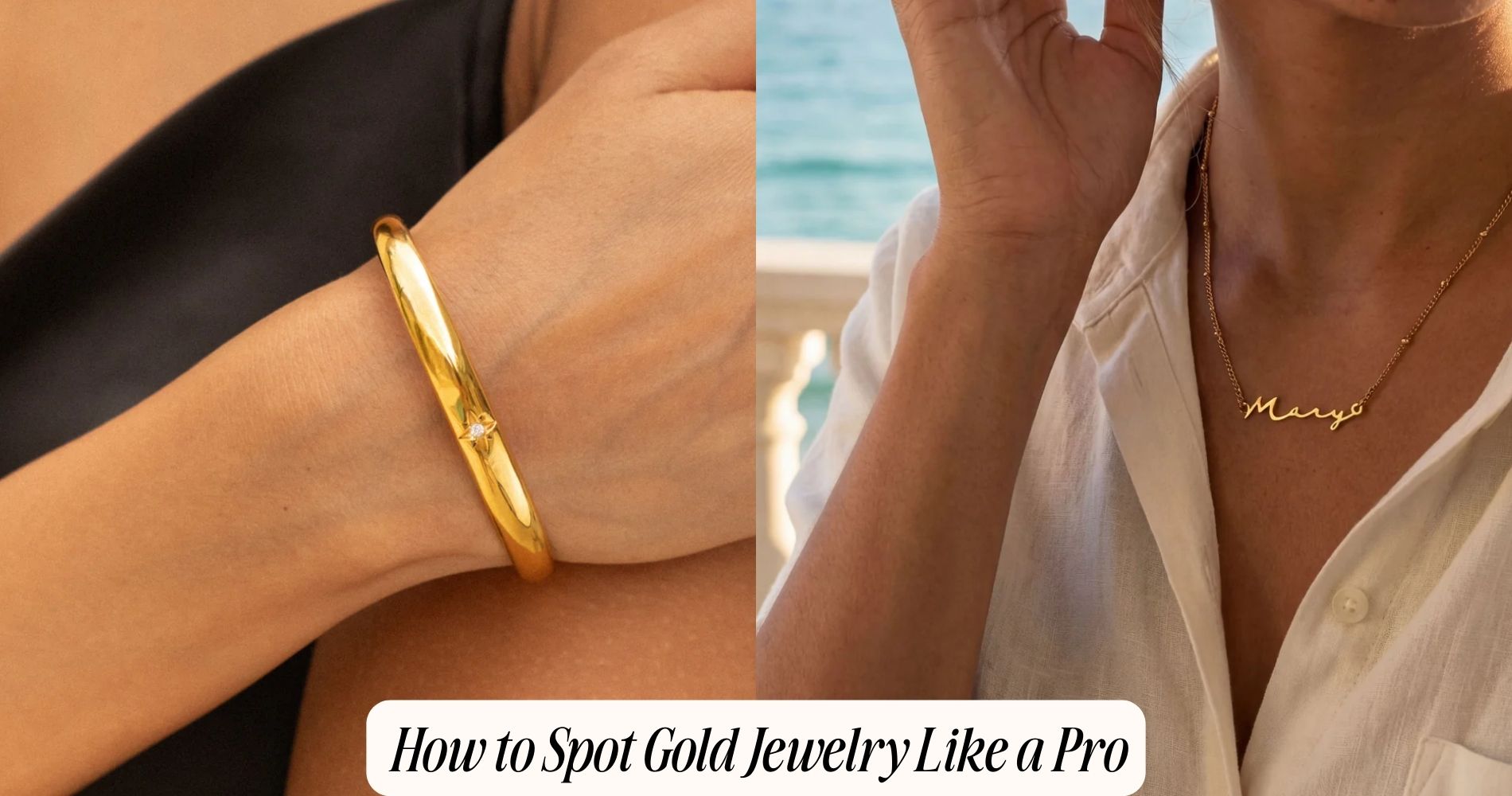
How to Spot Gold Jewelry Like a Pro
How to spot gold jewelry? You’ll spot real gold by checking consistent warm color and dense weight, inspecting hallmarks (750, 585, 375) and maker’s marks, and scanning for base metal at joints and prongs; use a loupe to verify sharp stamps and uniform patina, try a magnet (gold won’t cling), a ceramic scratch (gold leaves a yellow streak), and a sink test for density, and remember plating stamps like GP/HGP. These tips are especially helpful when evaluating sleek everyday pieces such as Atolea’s Minimalist Gold Necklaces collection. Keep testing methodically and you’ll uncover more practical checks and when to get a pro.
5 Quick Visual Signs of Real Gold
When you inspect a piece of jewelry, start by examining its color uniformity and surface behavior under direct light: real gold shows a consistent warm yellow (or white/pale for alloys) without streaks, tarnish, or greenish hues near edges or settings.
Its polished surfaces reflect light with a soft, dense luster rather than a glassy or mirror-like shine. You’ll note visual cues: uniform patina, crisp shifts at joins, and absence of base-metal exposure in beaded or filigree work.
Check hallmarks and gauge wear at stress points; genuine pieces retain tone where plating would flake. Assess solder joints and prongs—consistent alloy color indicates full-metal construction, while mismatched tones imply plating or repair.
Consider how jewelry design affects wear patterns and inspect accordingly.

Use Color & Weight to Gauge Purity
You’ve already used color and wear to detect surface plating and repairs; now focus on how the metal’s hue and heft indicate alloy and karat.
Inspect color variations under neutral light: pure 24K gold is a deep, saturated yellow, while 18K shifts slightly paler due to silver and copper alloys; 14K and 10K show progressively cooler tones and potential reddish or greenish casts depending on copper or nickel content.
Use weight measurement to corroborate visual assessment: calculate expected mass for the piece’s dimensions using gold density (24K ≈ 19.32 g/cm³; adjust lower for alloys) and compare with actual scale reading.
Significant deviations suggest plating, hollow construction, or non-gold alloys.
Record measurements and lighting conditions for repeatable evaluation.
Gold Hallmarks: Which Stamps Mean Real Gold
How can a tiny stamp settle doubts about a piece’s purity? You inspect hallmarks to verify composition: numeric marks (750, 585, 375) denote parts per thousand of pure gold—these are the technical shorthand for gold standards like 18K, 14K, 9K respectively.
Assayer marks, country codes, and maker’s marks provide provenance and certification authority. You’ll also see symbols indicating plating (GP, HGP) or trade names; those reduce intrinsic value.
Understand hallmark meanings precisely: a stamped fineness without an assayer or recognized assay office is less reliable. Look for consistent placement, sharp engraving, and standardized fonts—irregular or shallow stamps suggest later addition or counterfeit.
Use a reference of national hallmark systems when you need to confirm legitimacy before purchase.

5 Non‑Destructive Home Tests (Magnet, Scratch, Float, Loupe, Ring)
Want a quick, low-risk way to screen gold at home? Use a sequence of non-destructive checks: magnet test, loupe inspection, scratch/ring behavior, and float test.
For the magnet test, bring a strong neodymium magnet close; true gold is weakly diamagnetic and won’t cling, while ferrous or magnetic base metals will respond.
With a 10–20× jeweler’s loupe, inspect edges and solder joints for color consistency, stamping clarity, and surface wear that reveals core alloys.
For scratch/ring behavior, gently rub inconspicuous edges on unglazed ceramic—gold leaves a gold streak; plated items often show darker underlayers.
In the float test, place a cleaned item in still water; high-density gold sinks quickly, while lighter fakes may float or descend slowly.
Combine results for reliable screening.
When to Do an Acid Test : And When to Get a Pro
When should you reach for acid versus calling a professional? Use an acid test when you've completed nondestructive checks and need definitive karat verification on unplated items.
You'll clean a discreet area, apply the correct strength acid corresponding to expected karat, and compare the reaction against control streaks on a touchstone. That yields quantitative, immediate results but permanently affects a tiny surface area and requires proper safety gear, ventilation, and calibrated reagents.
Choose a professional appraisal when items are complex (multi‑metal, gemstones, hollow pieces), historically or monetarily significant, or when legal documentation is required.
A professional appraisal provides documented provenance, insured valuations, and access to XRF or fire assay for non‑destructive or destructive confirmation beyond what a home acid test can safely or accurately deliver.
Common Seller Tricks That Fake Real Gold
Because sellers want to close sales quickly, you'll often encounter deliberate tactics that make base-metal or plated pieces appear like solid gold.
You should recognize common seller techniques: heavy gold-tone plating over low-grade alloy, artificial patination to mimic age, and selective polishing to hide seam lines.
Deceptive practices also include removing or obscuring hallmarks, using lighting and magnification to emphasize luster, and substituting alloy-weighted pieces to simulate density.
Ask for provenance, request weight and dimensions, and observe edges, clasp construction, and joint finishes—technical details plating often conceals.
If a seller resists inspection or provides inconsistent documentation, treat that as a red flag.
Your goal is to expose inconsistencies in finish, weight, and marking before you commit.
Inspecting Rings, Necklaces, Bracelets, Earrings
Start by examining each type—rings, necklaces, bracelets, earrings—with a systematic checklist you can apply to every piece: weight and heft, hallmarks and maker’s marks, joint and clasp construction, visible wear on high-contact areas, and surface treatment at edges and inside surfaces.
For ring styles, check shank thickness, solder seams under bezels, and uniform patina in grooves.
For necklace designs, inspect link geometry, pinholes in soldered links, and clasp spring tension.
For bracelet types, assess hinge tolerances, end-cap joins, and stretch in multi-link assemblies.
For earring options, evaluate post thickness, back retention, and solder integrity at joints.
Use magnification, calibrated calipers, and a jeweler’s loupe to quantify dimensions and detect inconsistent plating or repaired areas.

Decide or Appraise: When to Trust the Test and When to Pay for Certification
Having inspected physical features and measured dimensions, you now need a decision framework for relying on in-field tests versus commissioning professional certification.
Balance test reliability, value at stake, and risk tolerance: use acid, magnet, and electronic assays for quick screening on low-value items or to triage lots. If results align, document readings and provenance; you can reasonably transact.
Opt for the certification process when items exceed your financial threshold, exhibit ambiguous markings, or will enter resale channels requiring guaranteed purity. Factor appraisal costs into the calculation: lab fees, shipping, and turnaround time can outweigh potential recovery on small pieces.
Maintain a checklist: item value, test concordance, seller transparency, and regulatory or buyer requirements before you decide to self-test or submit for formal appraisal.
Frequently Asked Questions
How Does Gold Respond to Extreme Heat or Flame Testing?
Gold melts but resists corrosion: you’ll note gold’s high heat resistance and minimal flame reaction, softening and melting near 1,064°C, while alloys show varied color changes and oxidation signs that reveal base metals under testing.
Can Gold Jewelry Cause Skin Allergies or Irritation?
Yes — gold jewelry can cause allergic reactions and skin sensitivity, especially when alloys contain nickel or copper; you’ll experience localized rash, itching, or dermatitis, so test metals, check hallmarking, and prefer high-karat or hypoallergenic alloys.
Do White Gold and Rose Gold Contain Real Gold?
Yes — both contain real gold: white gold composition mixes gold with white metals (nickel, palladium), while rose gold alloys blend gold with copper; you’ll assess karat purity and alloy percentages to determine true gold content.
How Does Gold Investment Differ From Jewelry Buying?
You focus on investment strategies, prioritizing purity, market liquidity, storage, and resale; jewelry buying emphasizes jewelry valuation, design premium, craftsmanship, and wearability. You’ll evaluate risk, fees, taxation, and emotional value distinctly.
Are Gold-Plated Items Repairable or Re-Platable Affordably?
Yes — gold-plated items are repairable and can be re-plated affordably depending on base metal, plating thickness, and damage. You’ll expect modest cost for re-plating; follow jewelry maintenance protocols to extend coating longevity.
Conclusion
You’ve learned practical, non‑destructive checks—color, heft, hallmarks, magnetism, surface tests with a loupe, float and scratch observations—and when to escalate to acid testing or professional appraisal. Rely on combined indicators rather than a single sign: consistent weight, accurate stamps, no strong magnetic attraction, and coherent wear patterns increase confidence. If uncertainty remains or value is high, get a certified assay or jeweler’s report to eliminate risk and establish marketable authenticity.








%20and%20maker%E2%80%99s%20marks,%20and%20scanning%20for%20base%20metal%20at%20joints%20and...)
コメントを書く
このサイトはhCaptchaによって保護されており、hCaptchaプライバシーポリシーおよび利用規約が適用されます。