


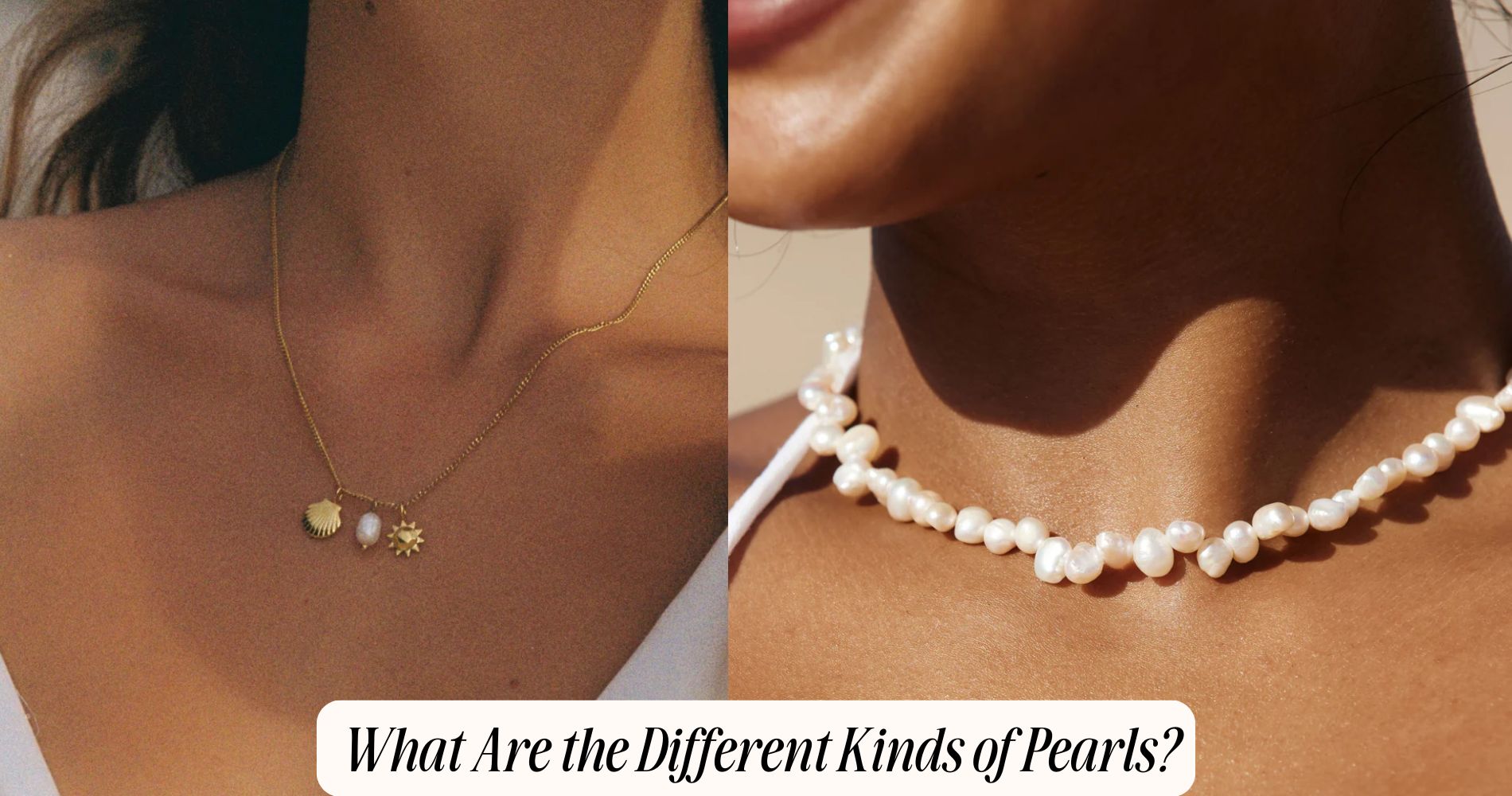
What Are the Different Kinds of Pearls?
What are the different kinds of pearls? You’ll encounter four main types: Akoya (4–9 mm, high luster, near-round), South Sea (10–15+ mm, silvery-white to deep gold, thick nacre), Tahitian (8–15+ mm, charcoal to peacock overtones), and freshwater (5–10 mm, nacre-rich, diverse shapes and colors). Natural pearls are extremely rare today, so most pearls you’ll see are cultured. The key quality factors are nacre thickness, luster, surface condition, shape, size, and how well a strand matches. Treatments can also affect color and value. If you love versatile, wearable pearls, Freshwater Pearls Jewelry offers a beautiful balance of durability, variety, and price—next, you’ll see exactly how to choose the right type for your style and budget.
Akoya Pearls
Prized for their high luster and near-round symmetry, Akoya pearls are saltwater cultured pearls primarily produced by the Pinctada fucata (Akoya) oyster in Japan and, to a lesser extent, China and Vietnam.
You’ll evaluate akoya pearl characteristics by examining nacre thickness, surface cleanliness, luster intensity, and overtone. Typical diameters range from 4–9 mm, with premium lots approaching 10 mm. High-luster specimens display sharp, mirror-like reflections; overtones commonly exhibit rose, silver, or cream. Roundness and matching are critical for strands, where tight tolerances indicate superior grading.
Understanding akoya pearl origins matters for quality expectations. Japanese farms emphasize longer cultivation and rigorous sorting, yielding finer luster and consistency.
You should verify treatments—routine bleaching and pinking—since they adjust color and uniformity but shouldn’t mask thin nacre or surface defects.
South Sea Pearls
Giants of the pearl world, South Sea pearls are saltwater cultured gems from Pinctada maxima oysters, primarily farmed in Australia, Indonesia, and the Philippines.
You’ll recognize South Sea origins by thick nacre grown over longer cultivation cycles, which yields exceptional durability and a satiny, diffuse South Sea luster. Expect South Sea sizes averaging 10–15 mm, with rare specimens exceeding 18 mm.
South Sea colors range from cool silvery-white to warm champagne and deep gold, driven by oyster strain and trace mineral content.
Because yields are low and growth is slow, South Sea pricing skews higher per millimeter than most cultured pearls. For South Sea jewelry, prioritize symmetry, clean surfaces, and matched overtones.
Practice South Sea care: soft cloth cleaning, last-on-first-off wear, and avoiding acids.
South Sea history includes early 20th-century natural fisheries and late-century cultured breakthroughs.
Tahitian Pearls
Although often called “black pearls,” Tahitian pearls are saltwater cultured gems from the Pinctada margaritifera (black-lipped) oyster, chiefly farmed in French Polynesia with production across other Pacific atolls.
When you evaluate Tahitian pearl origins, prioritize provenance documentation, as farm locale influences growth conditions, nacre deposition, and color distribution.
You’ll see body colors ranging from charcoal to dove gray, with overtones such as peacock, aubergine, pistachio, and teal. High-quality specimens exhibit thick nacre, clean surface, and sharp, mirror-like luster.
Shapes vary—round, near-round, drop, baroque—driven by grafting technique and environmental variables. Typical diameters span 8–15 mm, with rarer sizes exceeding 16 mm.
For Tahitian pearl jewelry, assess matching accuracy across hue, overtone, luster, and size. Expect premium pricing for round shapes, saturated peacock overtones, and flawless surfaces.
Freshwater Pearls
Workhorse of the pearl world, freshwater pearls are cultured primarily in Hyriopsis mussels across China’s lakes and rivers, with smaller output from the U.S. and Japan.
You’ll encounter nacreous pearls formed without a bead nucleus, yielding thick nacre layers, durable surfaces, and a softer luster than saltwater types. In freshwater pearl farming, technicians insert mantle tissue grafts, enabling multiple pearls per mollusk and diverse morphologies.
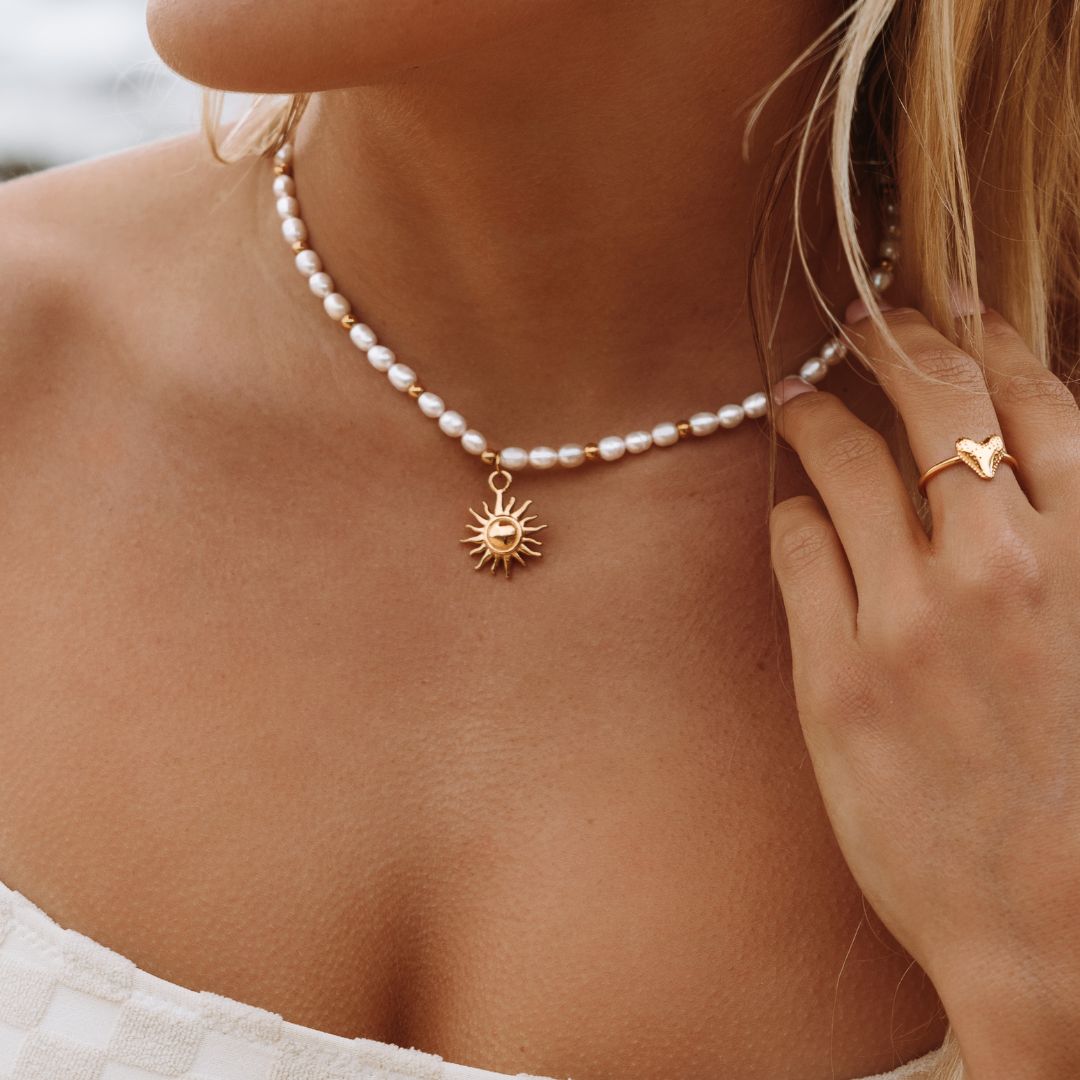
You can evaluate freshwater pearl varieties by size, shape, color, luster, and surface. Common shapes include round, near-round, button, oval, baroque, and keshi-like; sizes typically range 5–10 mm, with premium strands reaching 12–15 mm.
Color spans white, peach, lavender, and natural metallic overtones. Assess luster as sharp, bright, or satiny; scrutinize blemish frequency; and verify matching across strands for uniformity.
Natural vs. Cultured Pearls
While both form from nacre secreted around an irritant, natural pearls arise spontaneously in wild mollusks without human intervention, whereas cultured pearls result from deliberate grafting (and often bead-nucleation) by technicians.
You should distinguish them by origin, incidence, and diagnostics. Natural formation is rare; yields are extremely low, so natural pearls command higher prices and require X-radiography or micro-CT to confirm concentric nacre without a bead core.
Cultured pearls, produced via pearl farming, use mantle tissue and sometimes a spherical nucleus to initiate deposition, enabling predictable supply and size control.
You’ll evaluate luster, nacre thickness, and surface, but provenance remains the primary variable. Ethically, cultured production reduces pressure on wild stocks. Legally, disclosures must specify natural or cultured, nucleated or non-nucleated, to meet trade standards.
Pearl Shapes: Round, Baroque, and Beyond
Geometry governs pearl valuation as much as luster. You assess shapes along a spectrum: perfectly round, near-round, oval, button, drop, circle (ringed), and baroque. Round pearls command premiums due to rotational symmetry and uniform nacre deposition. Near-rounds offer visual roundness at lower cost. Ovals and buttons suit earrings and cufflinks where profile matters. Drops provide axial symmetry prized in pendants. Circle pearls display concentric ridges from periodic growth perturbations. Baroques—irregular, sculptural forms—maximize volume and surface interest.
Shape arises from pearl production techniques: nucleus size, insertion angle, tissue placement, and culture duration influence nacre accretion patterns. Bead-nucleated akoya and South Sea lines favor roundness; tissue-nucleated freshwater pearls yield diverse morphologies.
You’ll encounter unique pearl varieties—keshi, soufflé, and fireball—where atypical growth creates compelling silhouettes and high surface area.
Pearl Colors and Overtones
Three variables define pearl color perception: bodycolor, overtone, and orient. You evaluate bodycolor first—white, cream, silver, gold, or black—because host species and trace elements (e.g., manganese, copper) constrain the palette.
Next, you assess overtone, the semi-transparent tint layering the bodycolor. Common pearl overtone variations include rose over white, aquamarine over silver, and bronze over black; they arise from nanoscale nacre spacing that filters wavelengths by thin-film interference.
Orient, a spectral play of multiple hues across the surface, indicates coherent interference across the nacre stack.
You determine pearl color significance by context: white-rose suggests classic bridal conventions in Western markets; golden bodycolors (Pinctada maxima) project rarity; peacock overtones on Tahitian pearls signal premium demand.
Match overtone to skin undertone and ensemble palette to maximize chromatic harmony.

Nacre Quality and Luster
Because luster is a direct optical consequence of nacre structure, you judge nacre quality by thickness, aragonite tablet order, and translucency. Dense, well-aligned aragonite platelets create constructive interference, yielding sharp, mirror-like reflections. Thin or disordered platelets scatter light, producing chalky, diffuse shine.
In practice, you evaluate nacre thickness to gauge optical depth: greater cumulative layers increase path length and coherence, intensifying specular highlights and color return.
For rigorous luster assessment, observe reflected edges under neutral lighting. Crisp, high-contrast edges indicate uniform layering and low porosity; soft, blurred edges suggest suboptimal crystallographic order.
Rotate the pearl: consistent brightness across axes signals even deposition. Check body translucency at the drill hole or rim—semi-translucent margins with minimal concentric banding correlate with durable nacre and stable, high luster.
Grading and Sizing Standards
Although grading systems vary by origin and market, reputable schemes converge on a few measurable axes: surface quality, luster, nacre thickness, shape, matching, and size.
You should verify which grading criteria a seller uses—A–AAA, A–AAAA, or Tahitian A–D—because scales aren’t cross-compatible. Evidence from lab protocols shows that high luster with minimal blemishing correlates with thicker nacre and longer durability.
Symmetry matters: round pearls command premiums; baroque forms are graded for orient and surface integrity.
Assess size with standardized sizing methods. Vendors gauge diameter in millimeters, using digital calipers; strands report a calibrated range (e.g., 7.5–8.0 mm). Weighing in momme or grams validates uniformity.
For matched strands, color overtone and nacre reflectivity must align across pearls, not just dimensions.
Choosing Pearls for Different Styles and Budgets
Whether you favor minimalist studs or statement strands, align pearl type, size, and setting with your style usage and budget constraints.
For daily wear, choose durable, medium-luster Akoya or freshwater pearls in 6–7.5 mm; they balance elegance and cost.
For high-impact looks, select South Sea or Tahitian in 9–12 mm, prioritizing nacre thickness and surface cleanliness for camera-ready sheen.
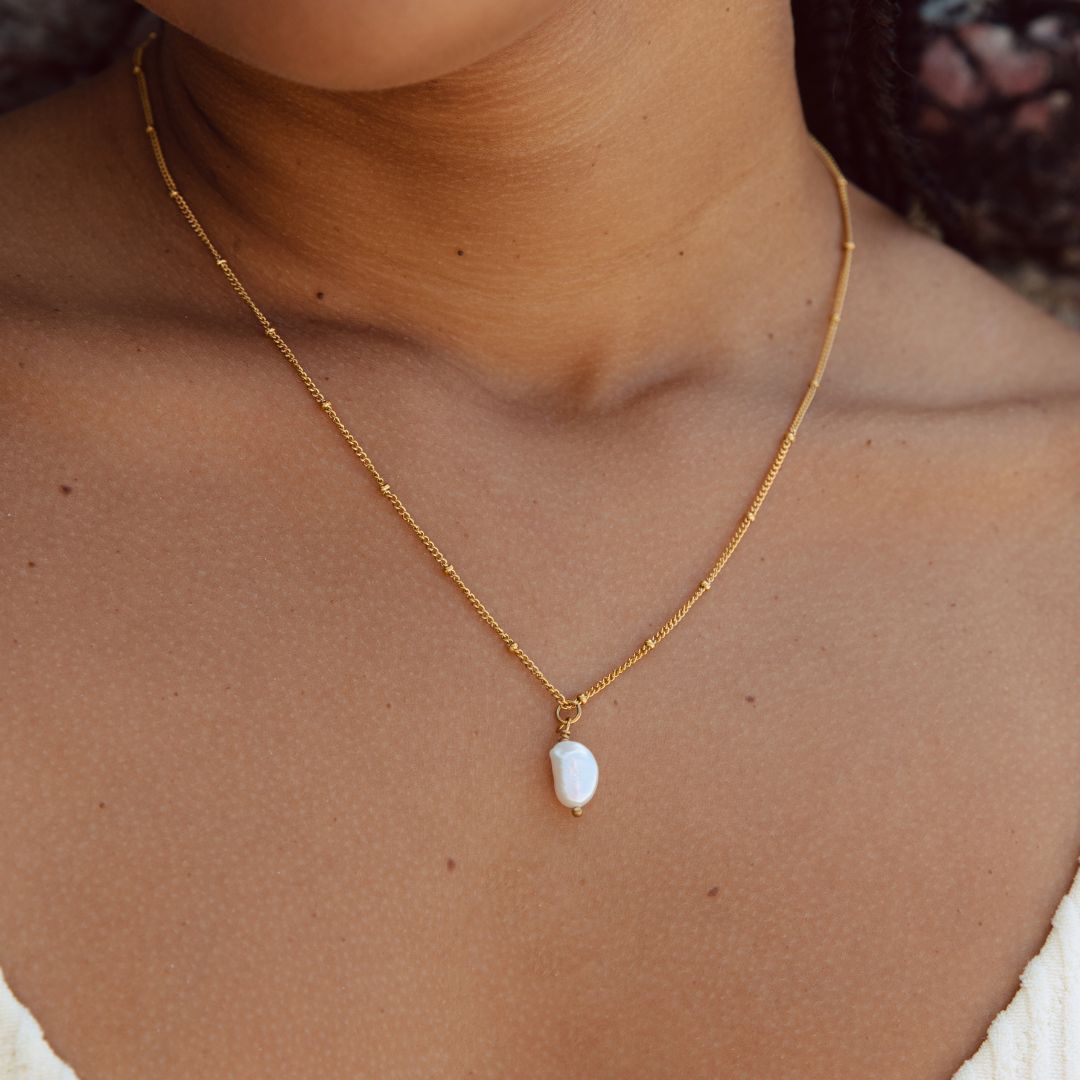
If you want budget friendly options, freshwater drops, baroques, and button shapes deliver presence at lower price points, especially on sterling settings.
Style recommendations: pair 5–6 mm studs with tailored basics; use 7–8 mm ropes for desk-to-dinner versatility; reserve 10–12 mm solitaires for formal attire.
Stretch dollars by choosing near-round over perfectly round, silver over gold, and excellent luster over marginal size increases.

Frequently Asked Questions
How Do Pearls Impact Ocean Ecosystems and Local Communities?
Pearls shape ecosystems and livelihoods: you support biodiversity when Pearl farming follows Ocean conservation, using regulated spat collection, habitat restoration, and water-quality monitoring. You also boost coastal incomes through traceable supply chains, resilient co-ops, and eco-certifications, mitigating overharvest, disease transmission, and invasive-species risks.
What Ethical Certifications Exist for Responsible Pearl Farming?
You’ll look for RJC Chain of Custody, MSC/ASC-aligned sustainable aquaculture claims, Fairtrade-style provenance audits, and SEIA/ESG reporting. Verify third-party audits, traceability to farms, biodiversity safeguards, worker protections, and grievance mechanisms. Demand transparent impact metrics and corrective-action documentation.
Can Pearl Jewelry Be Insured, and How Is Value Appraised?
Yes. You can insure pearl jewelry through scheduled personal property insurance policies. Insurers rely on appraisal methods evaluating nacre thickness, luster, surface quality, matching, size, shape, origin, and treatment disclosure, supported by gemological reports and recent comparable sales.
How Should Pearls Be Stored to Prevent Dehydration and Damage?
Store pearls in breathable pouches, not plastic; maintain moderate humidity control (40–60%) and stable temperature regulation (60–75°F). Keep them away from heat, sunlight, and acids. Wear them periodically; skin moisture prevents dehydration. Lay strands flat to avoid stretching.
Are There Vegan or Lab-Created Alternatives to Traditional Pearls?
Yes. You can choose vegan pearls like glass, cellulose acetate, or biopolymer beads, and lab created options such as cultured-pearl simulants grown without mollusks. Evaluate refractive index, surface luster, nacre-like layering, durability, and supply-chain transparency.
Conclusion
You’ve seen how Akoya, South Sea, Tahitian, and Freshwater pearls differ in origin, size, color, and luster. Weigh natural versus cultured provenance, then scrutinize nacre thickness, orient, and surface clarity. Apply recognized grading scales and diameter measurements to compare value. Match overtone and size to your complexion, wardrobe, and budget. Prioritize certified documentation and reputable vendors. With these criteria, you’ll select pearls that balance aesthetics, durability, and investment potential—confidence grounded in standardized metrics and market data.




,%20South%20Sea%20(10%E2%80%9315+%20mm,%20silvery-white%20to%20deep%20gold,%20thick%20nacre),%20Tahitian%20(8%E2%80%9315+%20mm...)
Leave a comment
This site is protected by hCaptcha and the hCaptcha Privacy Policy and Terms of Service apply.