


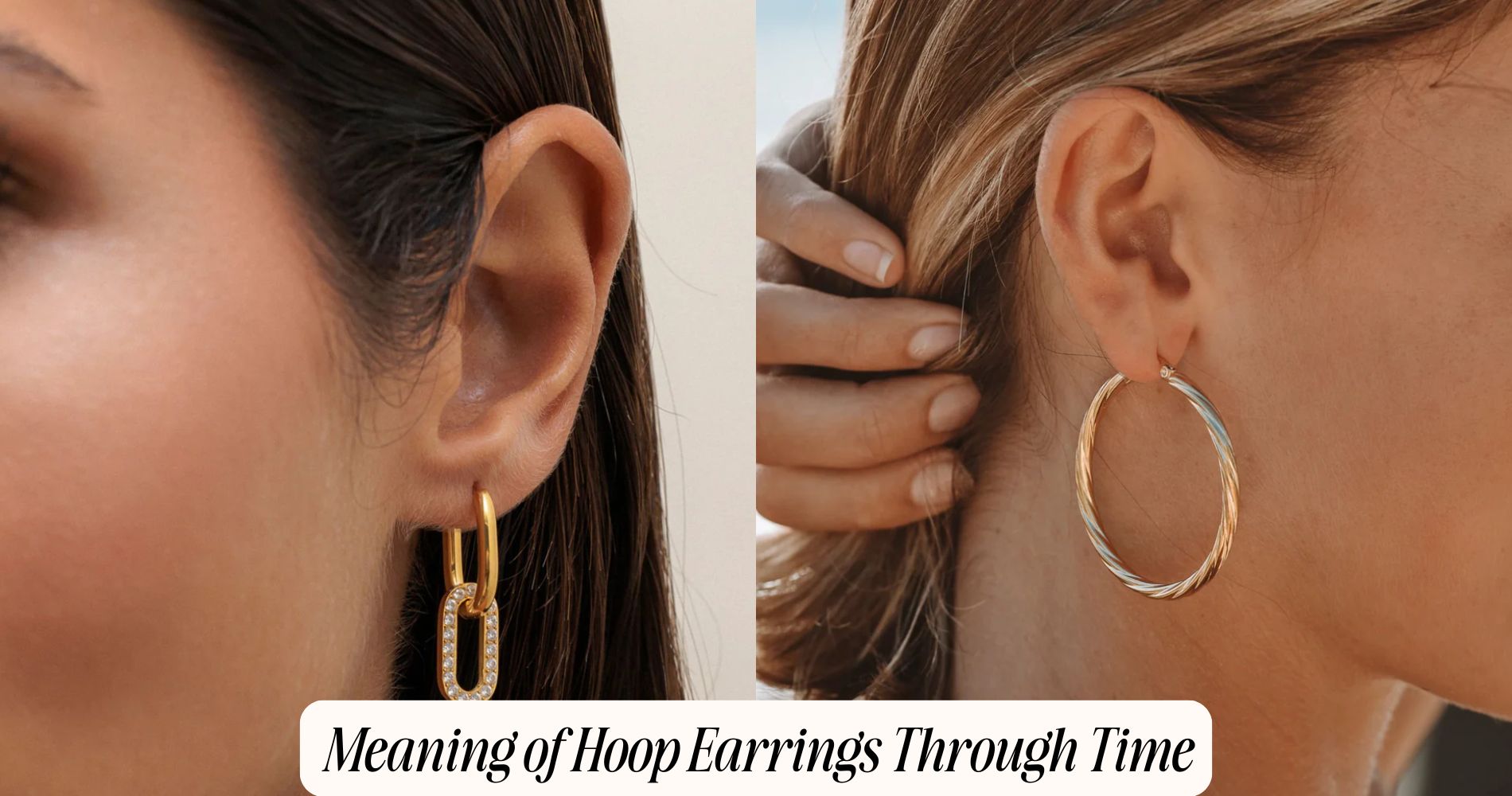
Meaning of Hoop Earrings Through Time
The meaning of hoop earrings shifts as they move through history: in ancient Mesopotamia and Nubia they signified status, protection, and skilled craftsmanship; in classical Greece and Rome they marked civic life and marriage; and in many African and Indigenous cultures they expressed identity and wealth. Through colonial trade their forms spread across continents, while 20th-century activists reclaimed hoops as symbols of pride and political self-assertion. Today, the meaning of hoop earrings can reflect fashion, heritage, or bold individuality—beautifully expressed through modern, comfortable designs like Atolea’s Hypoallergenic Hoop Earrings collection. Continue reading to trace their full historical journey.
Origins of Hoop Earrings
When you trace hoop earrings back, you find them emerging independently across ancient cultures—from Mesopotamia and the Indus Valley to Nubia and pre-Columbian Americas—because their simple circle and available metals made them easy to craft and potent symbols.
You follow a timeline where ancient craftsmanship first prioritized form and durability: copper, gold, and bronze were hammered into loops, often using basic tools and repeated techniques passed down generations.
You then see variation in size, ornament, and social meaning as communities adapted the form. Analytically, hoops functioned as identity markers, status indicators, and protective talismans, their cultural significance shifting with trade, metallurgy, and ritual.
You note continuity: the circle remained a versatile canvas reflecting each society’s priorities.

Hoop Earrings in Classical Europe
By the time Greek and Roman artisans took up the hoop, the form had already traveled centuries and continents, and you can watch it adapt to Classical Europe's tastes and technologies.
You trace its shift from simple metal rings to more elaborate designs as Hellenic workshops favored proportion and balance, then Roman fashion amplified variety: thicker bands, repoussé decoration, and gemstone insets.
Chronologically, you see social signals change—hoops mark status, civic identity, and marital cues—while techniques like lost-wax casting spread production.
Analytically, the hoop becomes a canvas: Artistic symbolism appears in engraved motifs referencing gods, victory, and domestic virtues, aligning personal adornment with public ideology.
You note material choices reflect trade networks and evolving aesthetic priorities across the Mediterranean.
Hoop Earrings in Medieval Europe
Moving from the Roman ateliers and their civic symbolism, hoop earrings in medieval Europe took on new meanings as imperial structures fractured and regional courts asserted local identities.
You trace a shift: early medieval hoops remained practical and modest, tied to regional dress codes and religious expectations, then evolve as trade revives ornament variety.
By the high Middle Ages, metalwork sophistication and imported gems let hoop silhouettes signal rank without overt ostentation.
You note medieval symbolism embedded in motifs—crosses, foliage—so hoops could convey piety or lineage.
In courtly contexts, nobility fashion adapted hoops into layered jewelry systems where size, material, and imagery marked alliance and status.
Chronologically, hoops reflect changing power networks and cultural exchange across Europe.

Hoops in African Cultures
Although hoop earrings have roots that predate recorded borders, their meanings and forms across Africa became deeply entangled with local materials, social roles, and trade networks over time.
You trace early copper and gold rings used by Nile and Sahel communities as markers of status and marital position, then follow coastal trade that introduced new shapes and techniques.
In the 19th and 20th centuries, colonial disruption shifted production and symbolism, yet communities adapted hoops into resistance and identity markers.
You analyze how design choices—size, metal, ornamentation—mapped onto age, clan, and wealth, preserving cultural significance.
Contemporary artists and designers draw from that lineage, blending tradition with Afrofuturism aesthetics to imagine future identities while honoring past meaning.
Hoop Earrings Among Indigenous and Latin American Peoples
Across the Atlantic and into the Americas, hoop earrings carried comparable weight as markers of identity, but they evolved under different materials, cosmologies, and colonial pressures.
You’ll trace pre-Columbian use among Maya, Aztec, Andean, and Amazonian communities where metals, shell, and bone signified rank, age, and spiritual ties; indigenous symbolism tied circular form to cycles, fertility, and the cosmos.
With conquest, you’ll see syncretism: European metals and Christian motifs merged with local meanings, while resistances preserved ancestral readings.
Across centuries, hoops became visible claims of belonging, gendered roles, and survival strategies.
Analytically, you’ll note how materials, ritual contexts, and colonial regulation reshaped cultural significance without erasing core cosmological associations.
Hoop Earrings as Trade Goods and Currency
When you follow trade routes from coastal markets to inland caravan fairs, hoop earrings emerge less as mere adornment than as portable wealth whose value shifted with material, size, and regional demand.
You trace early exchanges where copper and shell hoops circulated in barter systems between fishing communities and upland farmers, then watch silver and gold variants gain prominence as long-distance trade expanded.
Chronologically, you'll see local styles adapt through cultural exchanges with traders, missionaries, and itinerant craftsmen, altering economic significance as markers of wealth or convenient small change.
Analytically, consider how weight, recognizability, and malleability made hoops ideal for valuation, while their social meanings evolved alongside shifts in market integration and monetary practices.

Hoops as Amulets: Religion, Protection, and Superstition
A simple circle has long carried meanings beyond decoration, and hoop earrings often doubled as portable talismans whose significance changed with time and place.
You trace origins where metal rings marked rites—Bronze Age and Mediterranean wearers believed loops offered protection against envy and illness, embedding spiritual significance in daily dress.
Moving into medieval and Islamic contexts, hoops incorporated inscriptions or shapes tied to saints or protective verses, shifting cultural symbolism with belief systems.
In colonial and African diasporic settings, the hoop’s protective role adapted, blending ancestral amulets with new iconographies.
You analyze how material, inscription, and context determined perceived potency: small changes—size, metal, added charms—altered meaning.
Chronologically, the hoop remained a flexible, portable guardian across faiths and superstitions.
How 20th‑Century Activists Reclaimed the Hoop
Because the civil rights, Black Power, feminist, and Chicano movements converged on public visibility in the mid-20th century, activists deliberately turned hoop earrings into political statements as much as personal adornment.
You trace that shift chronologically: early protesters adopted bold hoops for visibility at rallies, then community leaders used them in portraits to assert dignity.
You analyze how activism symbolism was layered—hoops signaled resistance, unity, and defiance of dominant beauty norms.
By the 1970s and 1980s, you see women and men choosing specific sizes and styles to reference heritage and solidarity, increasing their cultural significance beyond fashion.
Your focus stays on agency and meaning, showing how a simple circle became an accessible emblem of identity and collective struggle.
How Fashion Cycles Made Hoops Modern Again (And What They Mean Today)
Although fashion’s pendulum keeps swinging, the hoop’s comeback in the late 1990s and 2000s wasn’t just nostalgia — designers, celebrities, and streetwear scenes deliberately reintroduced and retooled the earring across seasons, so you started seeing everything from micro-hoops to oversized, embellished rings in magazines, music videos, and runway shows.
You watched the hoop revival move from club culture into luxury houses, then into mainstream retail, each stage reframing its cultural significance. Chronologically, the cycle traces reinvention: practical street styles, celebrity endorsement, high-fashion reinterpretation, and fast-fashion ubiquity.
Analytically, that loop shows how trends borrow meaning—power, identity, glamour—then dilute or broaden it. Today, when you wear hoops you tap history and current identity politics, choosing size and finish to signal who you are.

Frequently Asked Questions
How Are Hoop Earrings Traditionally Made Today?
You’re typically crafting hoop earrings from traditional materials like gold, silver, and brass, then applying modern techniques — casting, CNC, soldering, and electroplating — evolving chronologically from hand-forged beginnings to precise, scalable production methods.
Do Hoop Earrings Cause Ear Stretching or Damage?
Hoop earrings can cause stretching or damage if you wear heavy styles or ignore ear care; choose suitable earring materials like lightweight gold, titanium, or surgical steel, monitor healing, and gradually increase size to avoid problems.
What Metals Are Best for Sensitive Skin?
You should choose hypoallergenic metals like surgical stainless steel, titanium, niobium, or 14–18K gold; historically preferences shifted as metallurgy improved, and analytically these minimize skin irritation while reducing allergic reactions and long-term sensitivity.
How Do Cultural Appropriation Debates Affect Hoop Wearing?
You’ll face debates where cultural significance clashes with fashion trends; as discussions evolve, you’ll analyze historical roots, note shifts in acceptance, and adapt choices respectfully, acknowledging origins while steering through contemporary style and potential appropriation critiques.
Are There Symbolic Meanings for Hoop Size and Thickness?
Yes — hoop symbolism shifts: historically, larger hoops signaled status or defiance while thin ones suggested subtlety; over time size significance evolved with fashion, politics, and identity, so you’ll read cultural, social, and personal layers.
Conclusion
You’ve traced hoop earrings from ancient practicality and status through medieval, African, Indigenous, and Latin American meanings, watched them circulate as trade and talisman, and seen activists reclaim them before fashion revived their symbolism. Chronologically, they shift from protection and wealth to resistance and identity; analytically, they reveal how materials, trade, religion, and politics shape meaning. In short, hoops keep circulating cultural value, adapting to each era’s needs while signaling continuity and change.







コメントを書く
このサイトはhCaptchaによって保護されており、hCaptchaプライバシーポリシーおよび利用規約が適用されます。